Fishin' Frenzy: What You're Actually Playing (and What It Costs When You Get It Wrong)
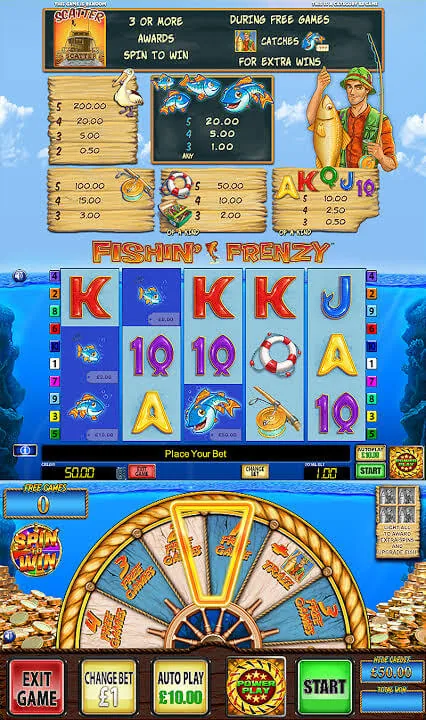
You're looking at a cartoon fisherman, five reels, and a big blue button. The demo counter says £100.00, but you haven't put a penny in yet. You tap spin, watch the reels land, and nothing happens. You spin again. Still nothing. Then a pelican lands, the screen lights up, and suddenly you're up £23.40 on imaginary money.
That's Fishin' Frenzy in the first sixty seconds — simple enough to play immediately, opaque enough that most beginners waste their opening deposit chasing features they don't understand. This guide unpacks the mechanics, explains the numbers that matter, and shows you where UK players actually go to play it legally. If you're wondering whether the demo is «practice» or just theatre, or why your mate's £50 lasted three minutes, you're asking the right questions.
What Fishin' Frenzy Is (and Where It Came From)
Fishin' Frenzy is a five-reel video slot built by Blueprint Gaming, a studio that sits under the Gauselmann Group in Germany but designs heavily for the British market. The theme is seaside fishing — rods, pelicans, lifebelts — rendered in primary colours and aimed squarely at players who want low cognitive load and a single, memorable feature.
It's not a crash game, not a live dealer table, not a progressive jackpot network. It's a classic video slot with fixed paylines and one free-spins bonus triggered by scatter symbols. The appeal isn't novelty; it's familiarity. You'll find it on nearly every UKGC-licensed site because it's been tested, certified, and played enough times that operators know it holds player attention without generating complaint volume.
Blueprint released the original, then added sequels: Megaways versions, Jackpot King tie-ins, and reskins. When someone says «Fishin' Frenzy» without a suffix, they usually mean the 2014 base game — ten paylines, medium volatility, a top prize around 5,000× your stake if you land the right combination during free spins.
How a Round Works (From the Player's Seat)
You set a stake — anywhere from £0.10 to the legal cap, which is £5.00 per spin if you're 25 or older, or £2.00 if you're between 18 and 24. That stake covers all ten paylines at once. You press spin, the reels stop, and the game checks for matching symbols left to right on any active line.
Low-value symbols are playing-card ranks (10, J, Q, K, A). High-value symbols are fishing tackle: rods, floats, boxes, pelicans. The fisherman is wild — he substitutes for anything except the scatter. Land three or more scatter symbols (the «Free Spins» sign) anywhere on the reels, and you trigger the bonus: ten free spins where every fish symbol that lands reveals a cash prize collected by the fisherman wild if he appears on the same spin.
That bonus is the entire game. Base-game wins are small and infrequent. Most sessions are a slow bleed until you hit three scatters, then a volatile swing — sometimes you collect £40.00 from a single free-spins round, sometimes you get one fisherman on spin nine and leave with £1.20. The RTP (return to player) sits around 96.12%, meaning the house edge is 3.88% over infinite spins. Variance is medium, so you'll see both long dry spells and short bursts.
The Numbers That Actually Matter
Three figures define every spin: your stake, the multiplier on any win, and the maximum possible payout. Here's what they mean in practice:
The 5,000× figure is theoretical — you'd need to fill the bonus-round reels with high-value fish symbols and collect them all with multiple fisherman wilds. In reality, most free-spins rounds pay between 10× and 100× your stake. A £1.00 spin might return £15.00; a £5.00 spin might return £80.00. Occasionally, you'll see £200.00+ from a single bonus. Rarely, you'll see four-figure sums. The maths is designed so that small wins are common, medium wins are regular, and large wins are memorable but infrequent.
Remember that the £5.00 and £2.00 stake caps are hard limits enforced by UK law. Every UKGC-licensed site will ask your age during registration and apply the lower cap if you're under 25. You can't override it. The cap exists because affordability checks now start at £150.00 net deposits per month, and the regulator wants to slow the rate at which younger players can lose money.
Where (and How) UK Players Actually Play It
Fishin' Frenzy is available on any casino site with a Blueprint Gaming catalogue and a valid UKGC remote licence. You'll find it at household names — Paddy Power, Betfair, Sky Vegas — and at smaller operators like Buzz Bingo or Grosvenor. The game itself is identical across all of them; what differs is the welcome offer, the withdrawal speed, and the quality of customer support when something goes wrong.
Every legitimate site serving British players must display its UKGC licence number in the footer and appear in the public register. If the footer is missing or vague, the site is unlicensed and illegal to use here. You won't get legal recourse if they refuse a withdrawal, and your bank may block the transaction anyway.
Before you deposit, you'll go through age and identity checks — usually a credit-reference lookup, sometimes a request for a photo ID or a utility bill. This is mandatory. Once verified, you can deposit using a UK debit card (Visa or Mastercard), PayPal, Apple Pay, Open Banking via Trustly, or paysafecard. Credit cards have been banned for gambling since 2020, and the payment method must be in your own name. If you use someone else's card, the site will block your account and void any winnings.
Withdrawals go to e-wallets in a few hours to 24 hours, to your bank via Faster Payments in the same day to two working days, or back to your debit card in one to three working days. The first withdrawal always takes longer — expect 24 to 48 hours while the operator checks your documents. After that, it's faster. Winnings are tax-free for you; the operator pays Remote Gaming Duty, which rose to 40% in April 2026.
| Operator Example | Welcome Offer (Example) | Withdrawal Time | UKGC Licence | |
|---|---|---|---|---|
| Paddy Power | Deposit £10, get 40 free spins (wager ×35) | E-wallet: 24 h, bank: 1–2 days | Check footer for number | → |
| Betfair Casino | Deposit £10, play with £40 (wager ×30) | E-wallet: 12–24 h, card: 1–3 days | Check footer for number | → |
| Sky Vegas | Deposit £10, get 50 spins (wager ×40) | E-wallet: 24 h, bank: same day to 2 days | Check footer for number | → |
Demo Mode vs Real Money (and What the Difference Costs You)
Most UKGC sites offer a demo version of Fishin' Frenzy. You click «Play for Free,» and the game loads with a fake balance — usually £100.00 or £1,000.00 in play money. The reels, the symbols, the bonus round, the RTP: all identical to the real-money version. The only difference is that you can't withdraw demo winnings, and you can't lose real money.
Demo mode is useful for one thing: learning the interface. You'll see where the stake controls sit, how the autoplay works, what the paytable says, and how often the bonus triggers. What demo mode won't teach you is what a losing streak feels like when it's your own £50.00, or how quickly £1.00 spins drain a £20.00 deposit when the bonus doesn't hit for forty spins.
Many players treat demo mode as «practice,» assuming that time spent in free play will improve their results in real money. It won't. The RNG (random number generator) doesn't care whether you've played ten demo spins or ten thousand. Each spin is independent. Demo mode is a UI rehearsal, not a training ground. If you're comfortable with the controls after twenty spins, you've learned everything demo mode can teach you.
One quirk: some sites only show the demo version to logged-in accounts that have already passed age verification. If you're asked to register before you can try the free version, that's normal on UK-licensed sites — it's a compliance measure, not a dark pattern.
The Mistakes That Cost Beginners Money (and How to Avoid Them)
First mistake: chasing the bonus. You go twenty, thirty, forty spins without triggering free spins, so you keep playing «just a few more» until the deposit is gone. The bonus trigger rate is roughly one in every hundred spins at the game's theoretical frequency, but variance means you might hit it twice in ten spins or not at all in two hundred. There's no pattern, no «due» moment, no way to predict it. If you set a stop-loss — say, £20.00 — and you reach it, you stop. That's the entire strategy.
Second mistake: ignoring the stake caps. If you're 18 to 24 and you set the stake slider to maximum, it'll cap at £2.00. Some players assume that's a bug or a site restriction. It's not — it's UK law, enforced by every licensed operator. If you're 25 or older, the cap is £5.00. You can't work around it, and trying to open multiple accounts to bypass it will get you excluded.
Third mistake: misunderstanding wagering requirements. You take a welcome offer — deposit £10.00, get 40 free spins — and you win £15.00 from the spins. You try to withdraw it and discover the £15.00 is locked behind a ×35 wagering requirement. That means you need to place £525.00 in total stakes before the £15.00 becomes withdrawable cash. Most of the time, you'll lose the bonus balance long before you clear the requirement. Wagering requirements aren't a trick, but they are a filter.
Fourth mistake: playing through affordability checks. If you deposit more than £150.00 net in a month, the operator will start affordability checks using credit-reference data. If you can't demonstrate that you can afford the deposits, they'll cap your account or close it. This isn't negotiable. The UKGC mandates it. If you're hitting the £150.00 threshold regularly, you're playing at a level that requires financial scrutiny.
- Set a loss limit before you start. When you hit it, close the tab.
- Understand that the stake cap is a legal ceiling, not a bug.
- Read the wagering requirement before you take a bonus. If it's ×35 or higher, you're unlikely to clear it.
- If you're depositing £150.00+ a month, expect the operator to ask for proof of income. If you can't provide it, they'll restrict your account.
Short Glossary (Terms You'll See on Every Spin)
- RTP (Return to Player): The percentage of all stakes the game is designed to pay back over infinite spins. Fishin' Frenzy sits at 96.12%, meaning the house edge is 3.88%. This is a long-term average, not a guarantee for any single session.
- Volatility: How the wins are distributed. Medium volatility means you'll see a mix of small frequent wins and occasional larger payouts, with dry spells in between.
- Scatter: The symbol that triggers free spins. You need three or more anywhere on the reels. It doesn't need to land on a payline.
- Wild: The fisherman symbol. Substitutes for any symbol except the scatter. During free spins, he collects fish prizes. In the base game, he just completes winning lines.
- Wagering Requirement: The number of times you must play through a bonus before you can withdraw it. A £10.00 bonus with ×35 wagering means £350.00 in total stakes.
- UKGC Remote Licence: The legal permit every online casino serving British players must hold. Look for the licence number in the footer and check it against the public register.
- GAMSTOP: The national self-exclusion scheme. One registration blocks you from every UKGC-licensed site for six months to five years. If you're worried about your play, it's the fastest way to stop.
FAQ
Can I play Fishin' Frenzy for free in the UK without registering?
Some UKGC-licensed sites allow unregistered demo play, but many require you to create an account and pass age verification first. This is a compliance measure, not a restriction. Once logged in, the demo version is identical to the real-money game — same RTP, same features, same interface — except you can't withdraw demo winnings.
Why is my maximum stake capped at £2.00 when I've seen others spin at £5.00?
If you're between 18 and 24, UK law caps your stake at £2.00 per spin on all slots. If you're 25 or older, the cap rises to £5.00. Every UKGC-licensed site enforces this automatically based on your date of birth. There's no override, and trying to open multiple accounts to bypass it will result in exclusion.
How often does the free-spins bonus actually trigger?
The theoretical trigger rate is roughly one in every hundred spins, but variance means you might see it twice in ten spins or not at all in two hundred. Each spin is independent. There's no pattern, no «due» moment, and no way to predict when the next bonus will land. If you're chasing it past your stop-loss, you're gambling on variance, not strategy.
What's the difference between the original Fishin' Frenzy and the Megaways version?
The original has five reels, ten fixed paylines, and a single free-spins feature. The Megaways version uses a variable-reel mechanic with up to 117,649 ways to win and adds cascading symbols. The RTP and volatility differ, and the bonus rounds work differently. When people say «Fishin' Frenzy» without a suffix, they usually mean the 2014 base game covered in this guide.
Are my winnings taxed if I play at a UK-licensed casino?
No. Gambling winnings are tax-free for the player in the UK. The operator pays Remote Gaming Duty — currently 40% as of April 2026 — on gross gaming revenue. You keep everything you win, whether it's £10.00 or £10,000.00. There's no reporting requirement and no tax return entry.
What happens if I deposit more than £150.00 in a month?
The operator will start affordability checks using credit-reference data. If you can't demonstrate that you can afford the deposits — through payslips, bank statements, or other evidence — they'll cap your account or close it. This is a UKGC requirement, not an operator policy. If you're regularly hitting the £150.00 threshold, expect scrutiny.